Posts

Multivitamin

  A meta-analysis of randomized controlled trials found a trend towards 6% reduction in all-cause mortality across primary prevention trials (RR: 0.94; 95% CI: 0.89, 1.00) ( 2013 ). The COSMOS-Mind trial found that daily multivitamin-mineral (MVM) supplementation for 3 years significantly improved global cognition (mean z = 0.07, 95% CI 0.02 to 0.12; P = .007) compared to placebo ( 2022 ) The Physicians' Health Study II found that daily multivitamin use was associated with a modest but significant 8% reduction in total cancer incidence (HR 0.92; 95% CI 0.86-0.998; P=.04) ( 2012 ). WHI study found that postmenopausal women with invasive breast cancer taking multivitamin had 30% lower breast cancer mortality risk compared to non-users (HR 0.70; 95% CI 0.55, 0.91) ( 2014 ). The 2022 study found no association between post-diagnosis multivitamin use and mortality in colorectal cancer survivors. (all-cause MV-HR = 0.97, 95% CI = 0.85 to 1.11; colorectal cancer-specific MV-HR = 1.00, 95...
Vitamin K2

Image
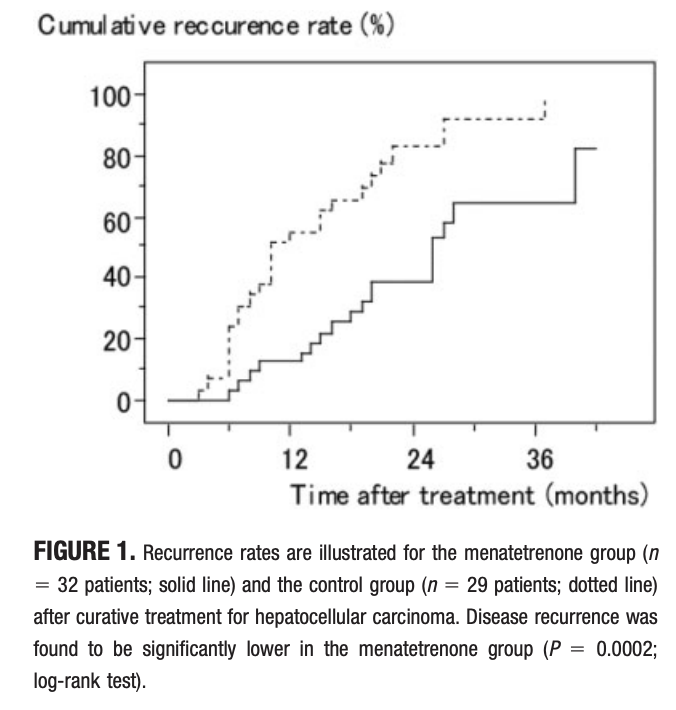
CANCER: A 2006 pilot study found that menatetrenone, a vitamin K2 analog, significantly reduced recurrence rates of hepatocellular carcinoma (HCC) at 12, 24, and 36 months and suggested potential benefits on survival, compared to a control group (P = 0.0002). A 2012 prospective randomized controlled trial showed that menatetrenone moderately suppressed HCC recurrence after hepatectomy, particularly in patients with normal preoperative Des-γ-carboxy-prothrombin levels (p=0.060). Vitamin K2 (3-10 μM) treatment in vitro induced apoptosis in leukemic blast cells from 15 MDS patients , with a more significant effect on blastic cells than mature myeloid cells or CD3-positive lymphoid cells, suggesting potential for MDS treatment in blastic transformation ( 1998 ) Administration of menatetrenone (45 mg daily) improved pancytopenia and transfusion-dependence in an 80-year-old MDS patient, suggesting potential for restoring hematopoiesis in MDS patients by inducing differentiation ( 1999 )...